APU’s Sharvin Christopher Adrian wins a national engineering trophy with an AI-driven heart-monitoring solution designed to make healthcare more accessible.
For final-year engineering student Sharvin Christopher Adrian, innovation is not only about making technology smarter. It is also about asking whom that technology can help.
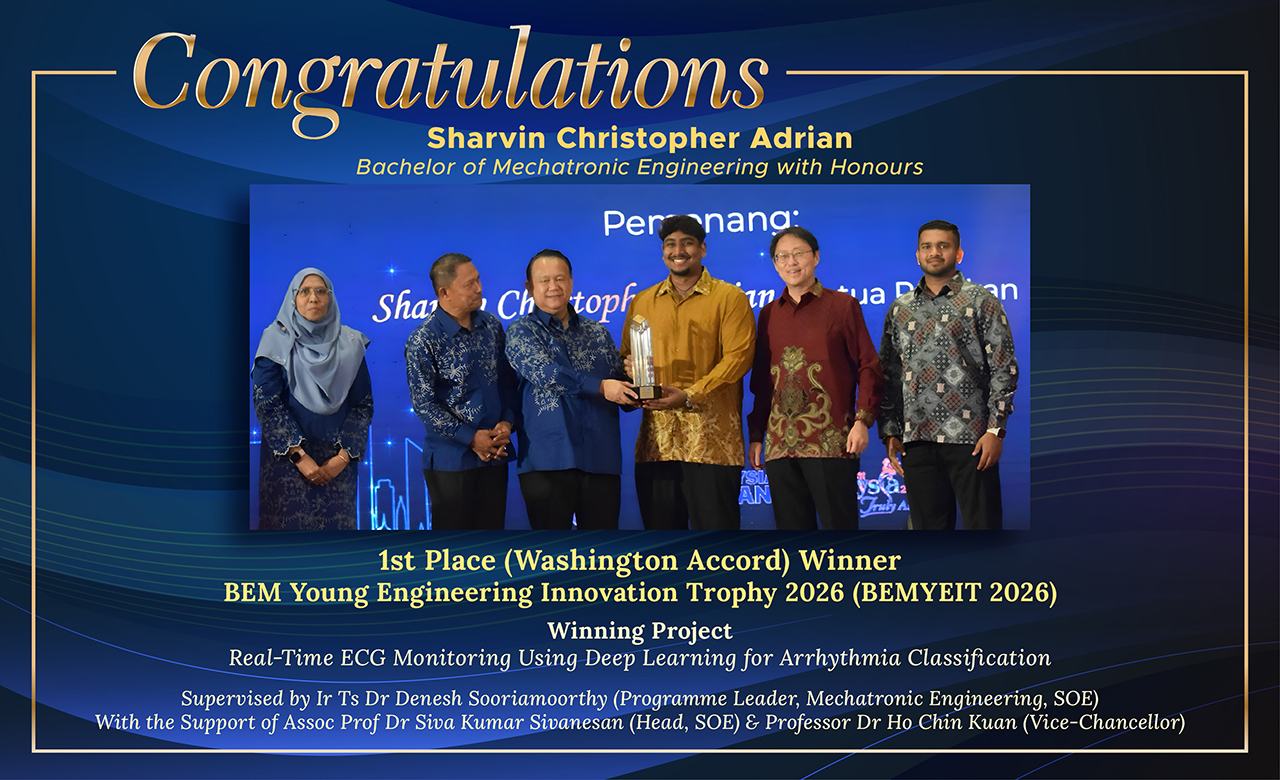
That conviction has taken the Bachelor of Mechatronic Engineering with Honours student from Asia Pacific University of Technology & Innovation (APU) to the national stage, where he emerged as the 1st Place (Washington Accord) winner of the inaugural BEM Young Engineering Innovation Trophy 2026 (BEMYEIT 2026).
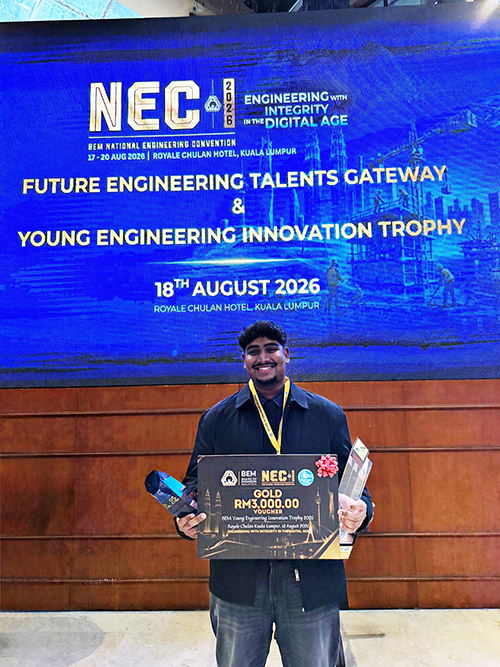
Organised by the Board of Engineers Malaysia (BEM), the competition was held on 18 August 2026 at The Royale Chulan Kuala Lumpur. Sharvin emerged victorious from a field of 29 finalists selected from more than 500 submissions nationwide.
His winning project, “Real-Time ECG Monitoring Using Deep Learning for Arrhythmia Classification”, demonstrates how engineering knowledge, artificial intelligence (AI) and a concern for healthcare accessibility can converge into a solution with real-world potential.
Making Heart Monitoring More Accessible
At the heart of Sharvin’s project is a simple belief: basic healthcare should not be determined by a person’s background or financial means.
The system addresses the need for earlier and more accessible detection of heart rhythm abnormalities, which can indicate potentially serious cardiac conditions.
It combines real-time electrocardiogram (ECG) monitoring with a deep learning model trained to automatically classify different types of arrhythmia. By automating the interpretation of ECG signals, the system could support faster preliminary screening and earlier intervention.
More importantly, its intended value extends beyond technical performance. Sharvin envisages a solution that could bring reliable heart monitoring closer to communities where access to specialist medical expertise and sophisticated diagnostic facilities may be limited.
In doing so, the project explores how engineering innovation can help narrow healthcare accessibility gaps rather than remain confined to well-resourced environments.
National Recognition for Student Innovation
Sharvin’s achievement was further celebrated during the inaugural National Engineering Convention 2026 gala dinner on 23 August at the same venue.
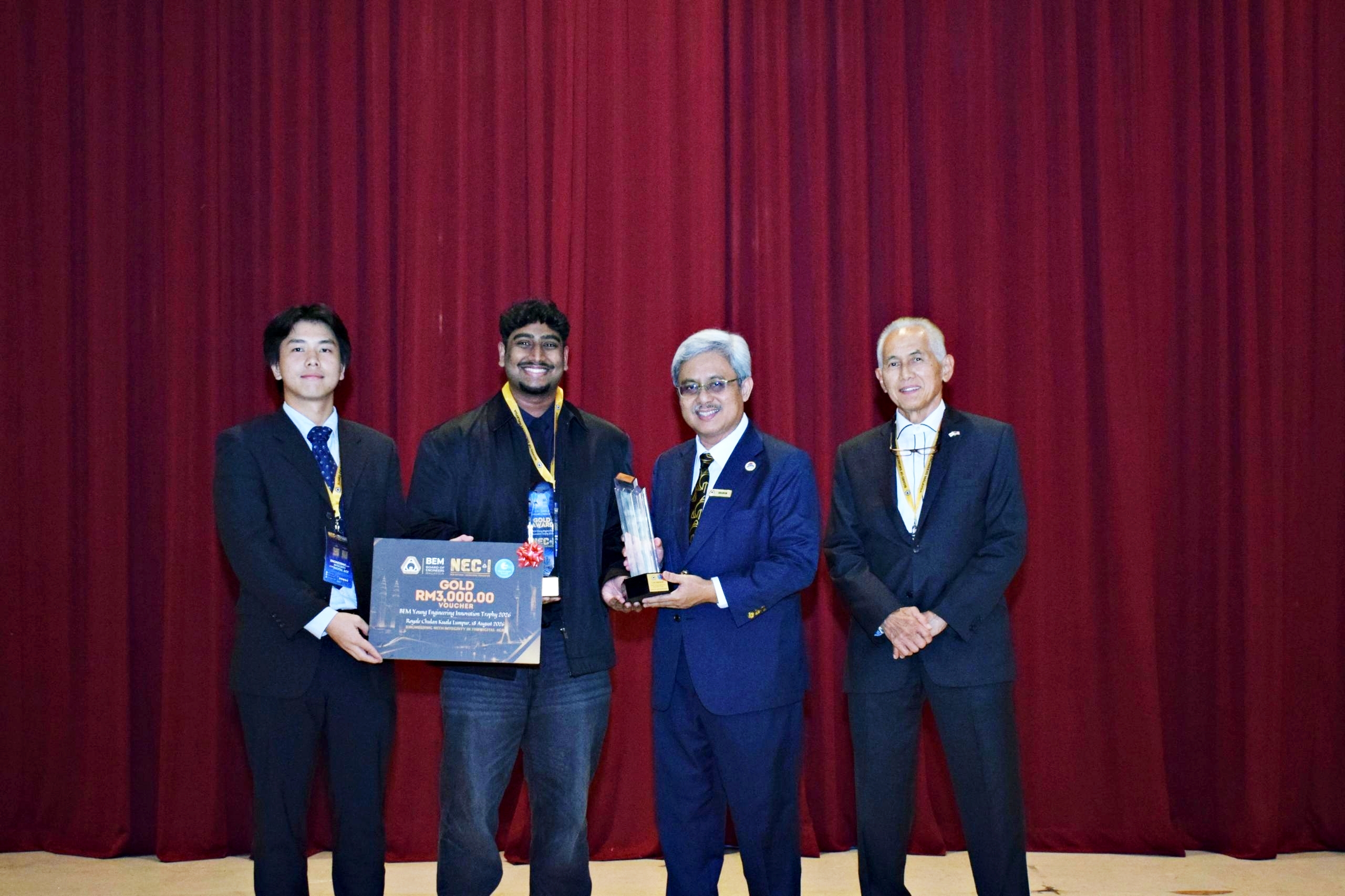
Accompanied by his supervisor, Ir Ts Dr Denesh Sooriamoorthy, Programme Leader for Mechatronic Engineering at APU’s School of Engineering (SoE), and APU Vice-Chancellor Professor Dr Ho Chin Kuan, Sharvin was invited onto the stage to receive the trophy from Minister of Works YB Dato’ Sri Alexander Nanta Linggi, and Director General of Works and BEM President Dato' Ir Ibrahim bin Esa.
Both the Minister and BEM President expressed interest in the project’s potential and encouraged Sharvin to consider pursuing a patent for his innovation, which also attracted press attention.
As the competition’s inaugural champion, Sharvin will hold the rotating challenge trophy until it is contested again at next year’s convention.
Mentorship Behind the Innovation
Sharvin developed the project under the supervision of Dr Denesh, whose technical guidance helped him refine both the engineering solution and its practical application.
Applauding his student’s achievement, Dr Denesh said the recognition reflected Sharvin’s commitment, creativity and perseverance in transforming engineering knowledge into something meaningful.
“His work in addressing a real-world healthcare challenge demonstrates strong technical capability, coupled with a thoughtful approach to accessibility and usability. It shows how student innovation can translate into meaningful contributions that respond to societal needs while advancing technology,” he said.
“Through opportunities such as this, APU encourages students to take applied learning beyond the classroom, strengthening their technical competencies, critical thinking and confidence to develop solutions for complex global challenges.”
Sharvin, meanwhile, expressed his heartfelt appreciation to Dr Denesh for guiding him throughout the project. He also thanked Prof Ho and Assoc Prof Dr Siva Kumar Sivanesan, Head of APU’s School of Engineering, for their encouragement and support throughout his journey.
Developing Engineers Who Care
Sharvin’s achievement reflects a broader purpose of engineering education: preparing graduates not only to understand complex technologies, but also to recognise the human problems those technologies can solve.
At APU, this holistic approach encourages aspiring engineers to combine professional competence with curiosity, empathy and social responsibility.
Because the most meaningful innovation is not necessarily the technology with the most sophisticated features. Sometimes, it is the solution that reaches someone who might otherwise have been left without one.
For Sharvin, a student project that began with ECG signals and deep learning has therefore grown into something larger: a demonstration that the engineer of the future can be both technically accomplished and deeply conscious of the people their innovations are meant to serve.
News & Happening
Download e-Brochures
Intake Calendar
Want to know more ?
Let’s Connect