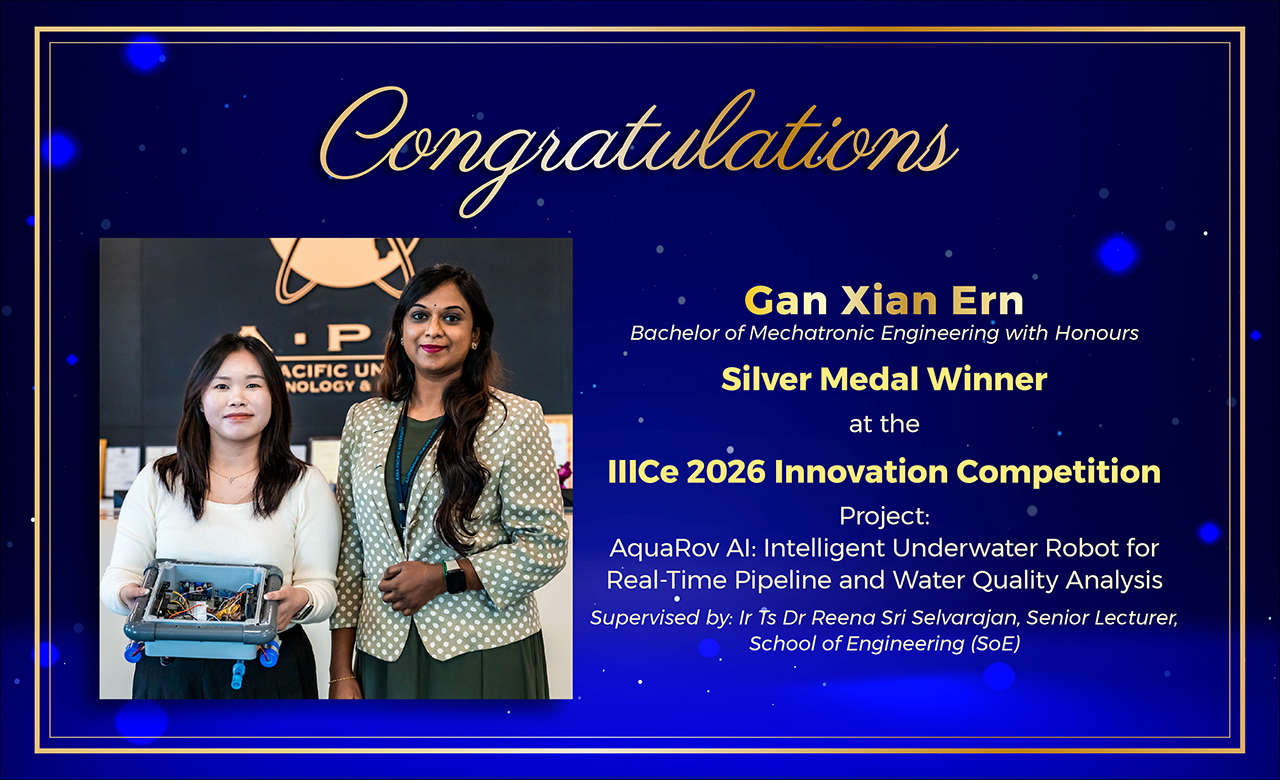
APU Mechatronics Engineering student Gan Xian Ern transformed her Final-Year Project into AquaRov AI, a functional underwater robotics prototype reaching an estimated Technology Readiness Level of 6–7 and earning a Silver Medal at the international IIICe 2026 Innovation Competition.
What began as a Final-Year Project (FYP) has progressed into a functional technology prototype with potential applications in infrastructure monitoring and environmental observation.
Gan Xian Ern, a Bachelor of Mechatronic Engineering with Honours student from the School of Engineering (SoE), Asia Pacific University of Technology & Innovation (APU), clinched a Silver Medal at the IIICe 2026 Innovation Competition for her project, “AquaRov AI: Intelligent Underwater Robot for Real-Time Pipeline and Water Quality Analysis.”
The hybrid competition, organised at Universiti Tun Hussein Onn Malaysia (UTHM), brought together participants and innovators from across borders. Winning projects were announced live on 5 August 2026.
Supervised by Ir Ts Dr Reena Sri Selvarajan, Senior Lecturer at APU’s SoE, AquaRov AI was developed as an intelligent underwater robotic system capable of supporting pipeline inspection alongside real-time water quality monitoring.
Combining underwater robotics, sensing technologies and Artificial Intelligence (AI), the system captures underwater visual and environmental data, while AI-assisted analysis supports the identification of potential infrastructure abnormalities.
Progressing Towards Operational Application
AquaRov AI’s journey to international recognition began with its submission through IIICe 2026’s official abstract process. Following screening by the organisers, the project was accepted and shortlisted for the competition.
Xian Ern subsequently presented the innovation through a project poster, video presentation and working prototype demonstration, allowing evaluators to assess not only its concept and innovation, but also its potential for practical application.
Significantly, the prototype has achieved an estimated Technology Readiness Level (TRL) of 6–7, reflecting its progression beyond conceptual and laboratory development towards a demonstrated prototype with potential for relevant operational applications.
This development highlights how an engineering FYP can evolve beyond an academic requirement into a tangible solution responding to real-world needs.
For Xian Ern, the achievement also represents the multidisciplinary nature of modern mechatronics engineering, where hardware development, sensing, intelligent systems and application-focused design converge to address complex challenges.
Engineering for Infrastructure and the Environment
Beyond its technical capabilities, AquaRov AI carries wider potential for infrastructure and environmental applications.
The project aligns particularly with the United Nations Sustainable Development Goal (SDG) 9: Industry, Innovation and Infrastructure, as well as SDG 14: Life Below Water.
By applying intelligent engineering technologies to underwater pipeline inspection and water quality observation, AquaRov AI demonstrates how emerging technologies can contribute towards smarter infrastructure management while supporting more sustainable approaches to environmental monitoring.
Its progression also reflects APU SoE’s emphasis on developing engineering solutions with relevance beyond the laboratory, encouraging students to consider the people, industries and environments that their innovations may ultimately serve.
Extending Student Research Beyond Competition
Recognition at IIICe 2026 may not be the final destination for AquaRov AI.
Following the competition, the project was invited for a journal submission, opening another pathway for Xian Ern’s FYP research to be further developed and disseminated through scholarly publication.
The progression — from abstract submission and competitive selection to international presentation, prototype demonstration, award recognition and a potential journal publication — demonstrates how undergraduate research can generate wider innovation and research outcomes when supported through sustained academic mentorship.
Dr Reena envisions taking AquaRov AI further beyond its current prototype stage towards real-world deployment. Her aspiration is guided by the belief that meaningful technological impact is ultimately realised when an innovation reaches its intended users and creates tangible value in practice.
Her mentorship of the project similarly reflects SoE’s commitment to nurturing students who can connect engineering theory with application, testing and societal needs.
Nurturing Engineers Who Build for the Real World
Affirming both the student’s achievement and the role of academic mentorship, Prof Ir Dr Siva Kumar Sivanesan, Head of APU’s School of Engineering, said the project demonstrated what could be achieved when students were encouraged to take their engineering ideas beyond academic assessment.
“Xian Ern’s achievement reflects not only her technical capability and perseverance, but also the importance of mentorship in helping students translate knowledge into solutions that can be demonstrated, tested and progressively brought closer to real-world use,” he said.
“I commend Dr Reena for nurturing this journey from a Final-Year Project into a tangible innovation with potential societal and industry relevance. This is the kind of engineering education we aspire to provide at APU — one that equips our students not merely to understand technology, but to apply it purposefully and create solutions that can make a meaningful difference.”
News & Happening
Download e-Brochures
Intake Calendar
Want to know more ?
Let’s Connect